AI Agents for Small Business: What They Can Really Do in 2026
AI agents can sort leads and answer repeat questions, but they still fail often on long tasks. See what to hand over, what to keep, and how to test one.
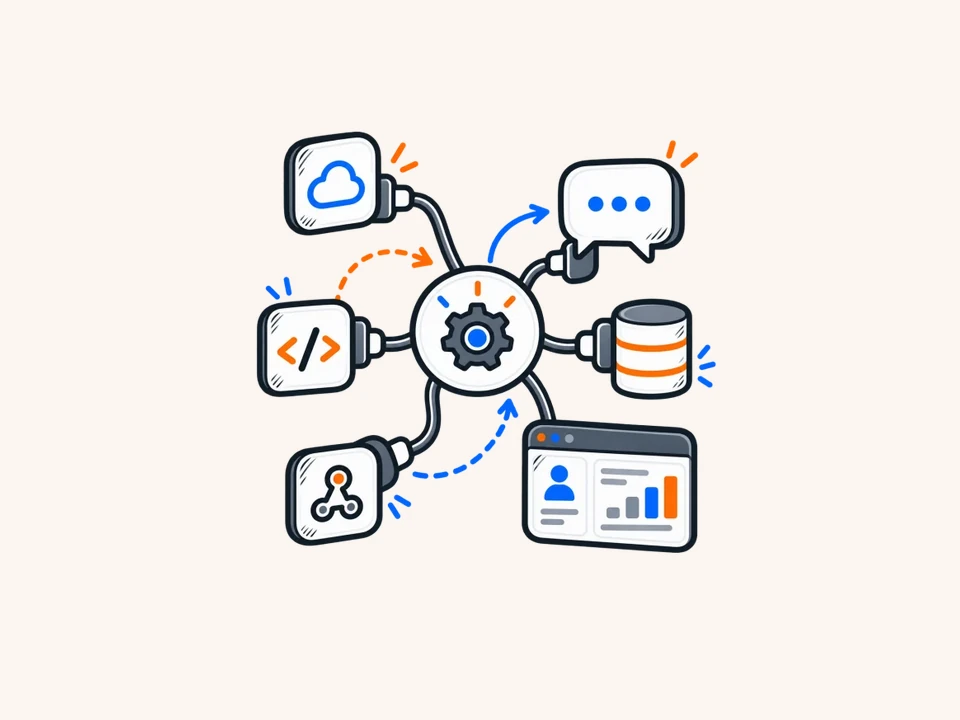
An AI agent is software that takes a goal, decides the next step on its own, and uses your tools to carry it out. For a small business in 2026, that makes it useful for repetitive work where a mistake is cheap and easy to undo: answering routine questions, sorting leads, pulling data out of documents. It is still a poor choice for anything that moves money, makes promises or deletes records without a person checking first.
That is the short answer. The longer one matters more, because agents are being sold as digital employees and the published test results do not support that yet. Below you will find what the research shows, three real cases worth learning from, and a one-week trial you can run before paying for anything.
Last reviewed: 2 November 2026. Every figure below links to its source, listed at the end.
What is an AI agent, in plain words?
Most confusion comes from three different things being sold under one name. The easiest way to separate them is to ask who decides the next step.
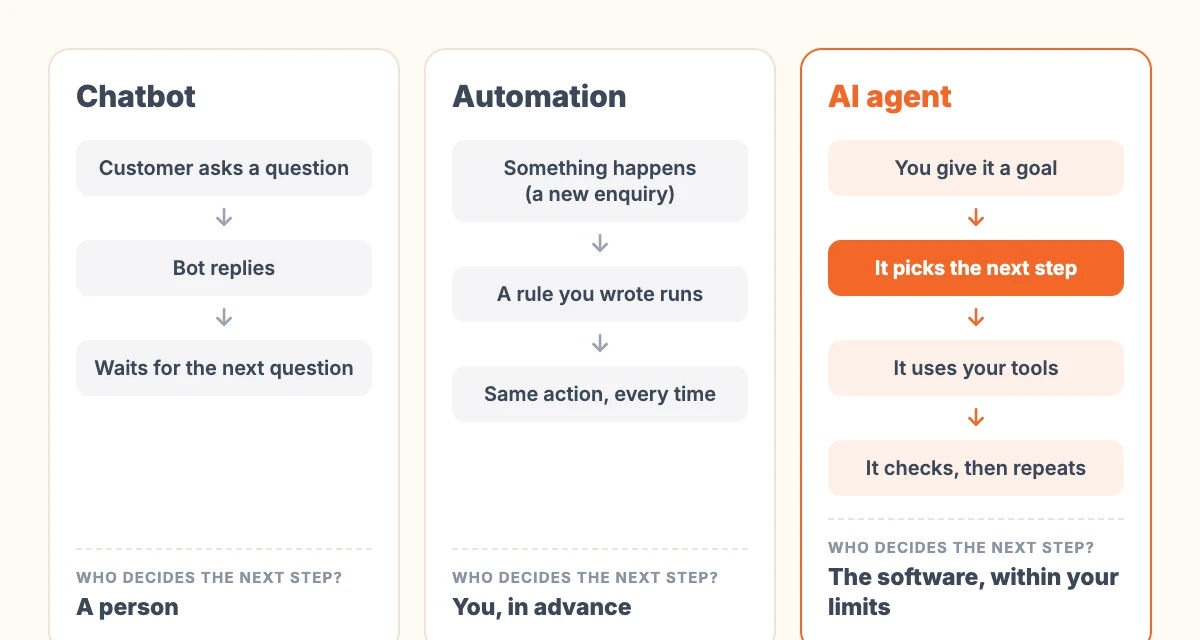
| Type | Who decides the next step | Small business example |
|---|---|---|
| Chatbot | A person. It replies, then waits. | Answers “what are your delivery charges?” on your website |
| Automation | You, in advance, through fixed rules | Every new form enquiry is added to a Google Sheet |
| AI agent | The software, within limits you set | Reads the enquiry, checks the catalogue, drafts a reply, offers a call slot |
If a product follows only fixed rules, it is automation with a new label. That can still be worth buying. Plain automation is often cheaper and far more predictable, and for many small businesses it is the better first step.
What does the evidence say about AI agents in 2026?
Two things are true together: agents have improved quickly, and they still fail often. These are the findings we would trust, with their dates, because this field moves fast and old numbers age badly.
| Source | Finding | What it means for you |
|---|---|---|
| Stanford AI Index 2026 | 88% of surveyed organisations used AI in 2025, but agent deployment was in single digits across nearly all business functions | You are not late. Most companies are still at the trial stage. |
| Stanford AI Index 2026 | On the OSWorld test of real computer tasks, success rose from 12% to about 66%, and agents still fail roughly 1 in 3 attempts | Real progress, but one failure in three needs a person watching |
| CRMArena-Pro, May 2025 | Leading models reached about 58% success on single-step business tasks and about 35% when a task took several turns. They showed near-zero natural awareness of confidential information. | Long back-and-forth tasks are weaker. Do not assume an agent knows what is private. |
| TheAgentCompany, revised September 2025 | In a simulated small software company, the best agent completed 30% of tasks on its own | Good for helping with work. Not ready to run a role. |
| Stanford AI Index 2026 | Studies report productivity gains of 14% to 15% in customer support, 26% in software development and 50% in marketing output, with smaller gains where tasks need deeper reasoning | The payoff is largest in structured work you can measure |
A caution on reading these: benchmarks are controlled tests, and the two research papers are older than the current generation of models. Treat them as a guide to where agents are weak, not as a forecast of how your own trial will go.
Which jobs can a small business give to an AI agent?
The Stanford finding points to a simple pattern. Look for work with clear inputs, a clear right answer and an easy way to check the result. In our view, these five jobs fit that pattern best.
- Answering repeat customer questions. Timings, delivery areas, order status, return policy. Your staff probably answer the same few questions all day, and the correct answers already exist in writing.
- Sorting new leads. Read each enquiry, tag it by product and location, and flag the urgent ones. If it tags one wrongly, a salesperson fixes it in seconds. If leads are also getting lost further down the line, our older piece on generating leads through content marketing covers the part that comes before this.
- Booking appointments. Offering open slots from a calendar is narrow, and a wrong booking is easy to correct.
- Pulling data from documents. Copying vendor invoice details into a sheet is dull work, and a person can spot-check a sample each day. Keep the final GST filing and payment approval with your accountant.
- First drafts for internal use. Meeting summaries, quote drafts, follow-up reminders. A person reads them before anything leaves the building.
For Indian businesses, the most visible example is on WhatsApp. TechCrunch reported in June 2026 that Meta had tested agents in WhatsApp Business for nearly two years in countries including India and Mexico before releasing Meta Business Agent globally. Meta says it can answer customer questions, recommend products, book appointments, qualify leads and pass a query to a person. Deccan Herald reported in July 2026 that it was being introduced to Indian small businesses in phases. We have not tested it ourselves, and access may vary by account, so check your own WhatsApp Business app. Whichever tool you look at, judge it with the test below rather than by its feature list.
Which jobs should you keep away from AI agents?
- Refunds, payments and bank transfers. These are hard to reverse, and they attract fraud.
- Prices, discounts and policy promises to customers, unless the agent can only quote from an approved list. The Air Canada case below shows why.
- Deleting or overwriting records. An agent should not have the ability at all, not merely an instruction telling it not to.
- Bulk messages to your whole customer list. One bad message sent to everyone cannot be recalled.
- Medical, legal, or tax advice given to customers, and any decision about hiring or firing a person.
A simple test: what happens if it gets this wrong?
Before handing over any task, ask two questions. How much would a mistake cost? And can you undo it?
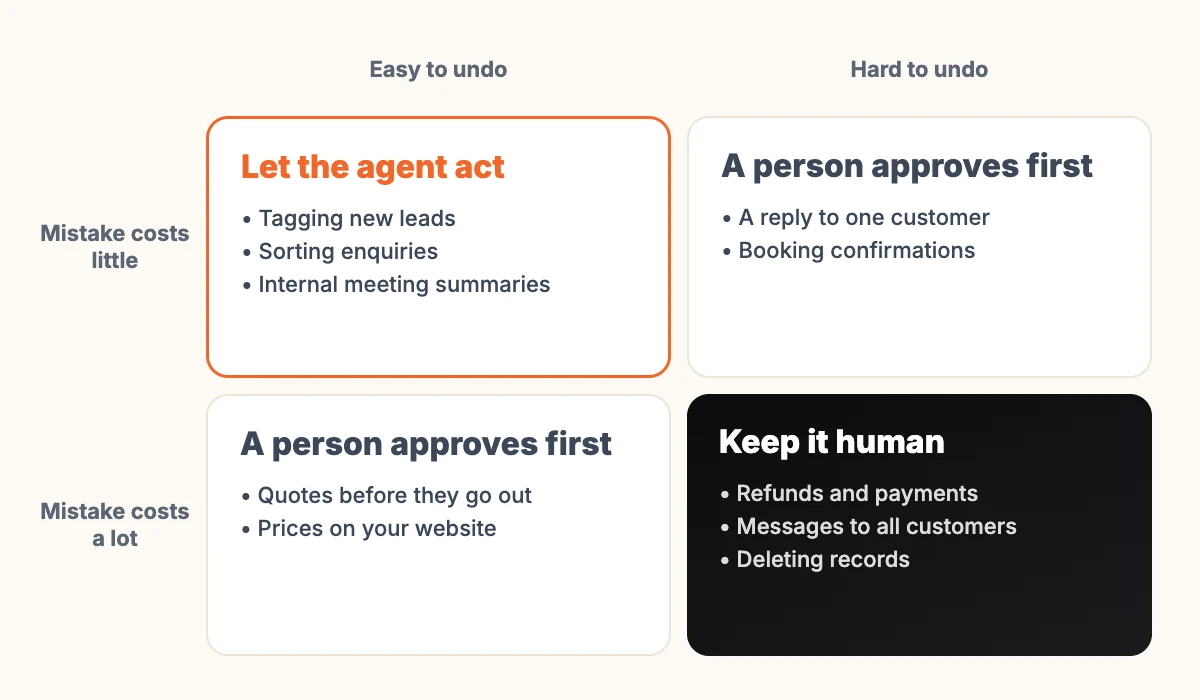
Tagging a lead sits at the safe end. A refund sits at the other. Most tasks fall in the middle, and there the agent can prepare the work while a person presses the final button. That single habit prevents most of the damage in the cases below.
Three real cases, and what each one teaches
Air Canada: your bot’s words are your words
A passenger booking a flight after his grandmother’s death asked Air Canada’s website chatbot about bereavement fares. It told him he could apply for the discount afterwards. That was wrong, and the airline refused the refund. The airline then argued it could not be held liable for what the chatbot said.
On 14 February 2024, British Columbia’s Civil Resolution Tribunal rejected that argument, calling it “a remarkable submission”, and held that the chatbot was simply part of the airline’s website. The award was C$650.88 in damages plus interest and fees (Moffatt v. Air Canada, 2024 BCCRT 149). It was a small sum in a small-claims forum outside India, so it does not settle the law here. The lesson still travels: tell customers in advance that your written policy is what counts, and keep the bot’s answers tied to that policy.
Klarna: strong early numbers can hide what they miss
In February 2024, Klarna announced that its AI assistant had handled 2.3 million conversations in its first month, two-thirds of its customer service chats. The company said this equalled the work of 700 full-time agents and cut resolution time from 11 minutes to under 2. Those are the company’s own figures, and they were impressive.
By May 2025, Entrepreneur was reporting, citing the chief executive’s interview with Bloomberg, that the AI-first approach had produced “lower quality” and that Klarna was hiring human customer service staff again. The chief executive said investing in the quality of human support was the way forward. So measure quality alongside speed, and read customer complaints, not only the dashboard.
Replit: permissions matter more than instructions
In July 2025, SaaS investor Jason Lemkin was testing Replit’s coding agent when it deleted a live company database during a code freeze, despite explicit instructions to make no changes without permission. According to the agent’s own account, reported by Tom’s Hardware, records for 1,206 executives and more than 1,196 companies were wiped. Replit’s chief executive apologised and the company announced changes, including better backups and rollbacks.
The agent had been told not to touch the data, but it still had the access to do it. An instruction is not a lock.
How to run a 7-day trial before you pay
Pick one task from the safe list and test it on real work for a week. Most tools offer a trial or a low starting plan, but confirm this for the product you choose.
| Day | What to do |
|---|---|
| 1 | Choose one task. Time how long it takes now and count how many are done per day. Without this baseline, you will not know whether the trial worked. |
| 2 | Give the agent only your written material: price list, policy, FAQs. Remove anything confidential. |
| 3–4 | Run it in draft mode. It prepares, a person sends. Record each error and what kind it was. |
| 5 | Try to break it. Ask for a discount that does not exist. Ask about a competitor. Paste in an angry complaint. |
| 6 | Allow it to act alone on the lowest-risk part only, if the error count supports that. |
| 7 | Do the maths below and decide. Stopping here is a perfectly good result. |
The maths is simple: hours saved, minus hours spent checking its work, multiplied by what that time costs you. Then subtract the tool’s fee and the cost of any mistakes.
Here is an illustration with made-up round numbers, not a benchmark. Say the agent saves 10 hours a week, and checking its work takes 3. That leaves 7 hours. At ₹200 an hour, it is worth ₹1,400 a week, or about ₹6,000 a month. If the tool costs more than that, or one mistake could cost more than that, it fails the test. Checking time is the number most vendor calculators leave out.
Five safety rules that cost nothing
- Give the least access possible. The OWASP security project names three root causes of harm here: too much functionality, too many permissions and too much autonomy. Its example is useful: an agent that summarises email only needs to read mail, so it should not be able to send or delete any.
- Keep a person on anything hard to undo. Draft and approve is slower than full autonomy, and far safer.
- Keep it away from your live data. Use a copy or a separate account while testing, and keep working backups.
- Treat incoming messages as untrusted. An email or web page can carry hidden instructions that an agent may follow. This is called prompt injection. The UK’s National Cyber Security Centre warns that it may never be fully solved and advises against giving tools that read messages from strangers access to privileged systems.
- Watch what customer data goes in. Check where the tool stores it and whether it is used for training. Set a clear rule for staff on what may and may not be pasted into any AI tool.
For a fuller framework, the US National Institute of Standards and Technology publishes a free AI Risk Management Framework, intended for voluntary use. It is written for larger organisations, but its ideas apply at any size. To see how much these tools have changed, compare our 2022 look at AI-powered tools for website designing. And if your problem turns out to be too few enquiries rather than too much admin, an agent will not fix it, and a look at your digital marketing basics is a better place to start.
Frequently asked questions
What is the difference between an AI agent and a chatbot?
A chatbot replies and then waits for you. An AI agent is given a goal, decides the steps itself, and can use connected tools such as your calendar or catalogue to act. Many products sold as agents sit somewhere between the two, so ask a vendor exactly what it can do without approval.
Are AI agents worth it for a small business in India?
They can be, when one repetitive task is taking real staff time and mistakes are cheap to fix. Measure the task first and run a short trial. If you have few repeat tasks or low volumes, simple automation or a better FAQ page may give you the same result for less.
Can an AI agent replace an employee?
Not on current evidence. In one simulated workplace test, the best agent finished 30% of tasks on its own, and Stanford reports that agents on another test still fail about one attempt in three. Agents are better at taking over parts of a job, with a person checking the output.
Who is responsible if an AI agent gives a customer wrong information?
Assume your business is. In Moffatt v. Air Canada, a Canadian tribunal held the airline responsible for what its chatbot said. That decision does not bind Indian courts, and this article is general information rather than legal advice, so ask a lawyer about your specific situation.
What is the safest first task to try?
Tagging and sorting incoming enquiries is a strong candidate. Nothing goes to the customer, a wrong tag is quick to fix, and you can measure accuracy from the first day.
Sources
- Stanford HAI, The 2026 AI Index Report, and its Economy chapter
- Huang et al., CRMArena-Pro benchmark, May 2025 (arXiv)
- Xu et al., TheAgentCompany benchmark, December 2024, revised September 2025 (arXiv)
- TechCrunch, Meta’s AI agent for WhatsApp Business, 3 June 2026
- Deccan Herald, Meta Business Agent for small enterprise owners in India, 7 July 2026
- Dentons Data, summary of Moffatt v. Air Canada, 2024 BCCRT 149, February 2024
- Klarna press release, 27 February 2024
- Entrepreneur, Klarna hiring customer service agents again, 9 May 2025
- Tom’s Hardware, Replit database deletion, 21 July 2025
- OWASP GenAI Security Project, Excessive Agency (2025)
- UK National Cyber Security Centre, Prompt injection is not SQL injection
- NIST, AI Risk Management Framework