GEO vs SEO vs AEO: The Difference and What to Do First
SEO, AEO and GEO overlap more than the acronyms suggest. See the real difference, where Google and Microsoft disagree, and what to do first.

SEO is the work of being found in search results. AEO, answer engine optimisation, is about having your content used as a direct answer, the way featured snippets and voice assistants work. GEO, generative engine optimisation, is about being used and cited inside AI-written answers such as Google AI Overviews or Microsoft Copilot. In practice they overlap far more than the three acronyms suggest. Google says plainly that optimising for its generative AI search “is still SEO”. So for most businesses, the right first step is not a separate GEO project. It is strong SEO, with answers written so they are easy to lift.
Google and Microsoft do give slightly different advice on the details, and we cover where, along with one real decision we made on our own website.
Last reviewed: 7 November 2026. Sources are listed at the end.
What is the difference between SEO, AEO and GEO?
| SEO | AEO | GEO | |
|---|---|---|---|
| Full name | Search engine optimisation | Answer engine optimisation | Generative engine optimisation |
| The goal | Rank in search results and win the click | Be the direct answer to a question | Be used and cited inside an AI-written answer |
| Where it shows | The list of results | Featured snippets, “People also ask”, voice answers | AI Overviews, AI Mode, Copilot and similar tools |
| What you measure | Impressions, clicks, positions | Snippets won, questions answered | Citations and impressions in AI features |
| Where you measure it | Search Console, Bing Webmaster Tools | Same tools, plus checking results by hand | Google’s Generative AI performance report, Bing’s AI Performance report |
Notice the last two rows. Until this year, GEO was mostly guesswork, because nobody could see where they were being cited. That changed in 2026. Bing added an AI Performance report to Bing Webmaster Tools in February, and Google said in August that its new Search Console insights for generative features had reached all websites worldwide. If someone sells you GEO without using either report, ask why.
Where did the term GEO come from?
The term comes from a research paper first published in November 2023 and revised in June 2024. The authors defined “generative engines” as search systems that gather information from several sources and summarise it, and proposed GEO as a way for content creators to improve their visibility in those answers. In their own benchmark, they reported that some content changes boosted visibility “by up to 40%”, and that what worked varied by subject.
Two cautions before anyone quotes that 40% at you. It was measured in a research setup, on the AI systems available in 2023, not on today’s Google or Bing. And the authors themselves found the effect depended on the domain. It shows that wording and structure can matter. It is not a promise of results.
How the three fit together
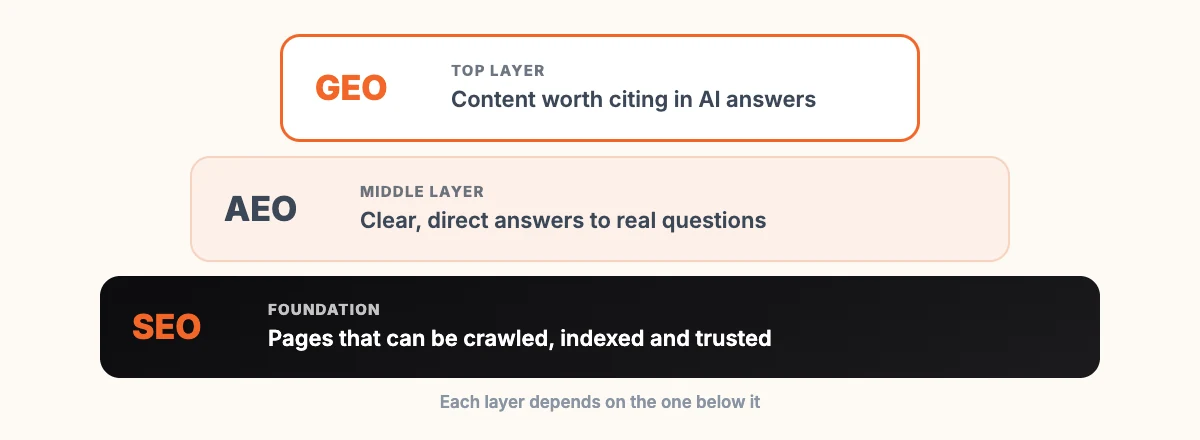
Think of it as a stack. If a page cannot be crawled and indexed, it cannot be a featured snippet, and it cannot be cited in an AI answer either. Google’s documentation says this directly: its AI features are built on the same core Search ranking and quality systems, and a page must be indexed and eligible for a snippet to appear in them. Microsoft makes a similar point in its own guidance: “Traditional SEO is still essential.”
So treating AEO or GEO as a replacement for SEO gets the order backwards. They are better seen as extra care on top of it: how clearly you answer, and whether your content is worth quoting.
One page, checked three ways
The difference is easiest to see on a single page. As an illustration, take a made-up dental clinic in Noida with a page about teeth whitening, and check it with each lens in mind.
| Lens | The question to ask | What a good page has |
|---|---|---|
| SEO | Can the page be found and does it deserve to rank? | It is indexed, loads quickly on a phone, has a clear title and description, and other pages on the site link to it. |
| AEO | Does it answer the questions people actually ask? | Headings such as “How long does whitening last?” and “Is it safe for sensitive teeth?”, each followed by a short, direct answer. |
| GEO | Would an AI answer have a reason to cite this page over others? | Something only this clinic can say: the dentist’s own aftercare advice, a real price range it is willing to stand behind, and when it would advise against the treatment. |
Most of the effort sits in the first two rows, and those are what most pages get wrong. The third row is where pages usually stand out or disappear. A page that repeats the same general advice as fifty others has little to offer an AI answer that has already read those fifty.
The checks also catch problems the acronyms hide. If the price is only in a downloadable PDF, the page fails the AEO check. If the timings on the website do not match the clinic’s Business Profile, people and search tools get conflicting answers; Google recommends keeping Business Profile details current for exactly this reason. And if the answers sit inside a collapsed accordion, Microsoft’s guidance suggests AI systems may never see them.
Run this on your five most important pages before buying any new service. It costs nothing, and it usually shows where the real gap is.
Where Google and Microsoft give different advice
Both companies have published guidance, and they mostly agree. They differ on how much to shape content for AI, which most comparisons miss.
| Topic | Google (May 2026 guide) | Microsoft (October 2025 guide) |
|---|---|---|
| Is SEO still the base? | Yes. Generative AI search is “still SEO”. | Yes. “Traditional SEO is still essential.” |
| Shaping content for AI | No need to split content into small “chunks” or rewrite it specially for AI | Write “snippable” content: concise answers, lists, Q&As and tables |
| Structured data | Not required for AI features, still useful for rich results | Use schema to label your content clearly |
| Hidden content | Make sure important content is available as text | Do not hide important answers in tabs or expandable menus |
| Special AI files | Not used by Google Search; neither helps nor harms | Not covered in the guide we read |
These are less in conflict than they look. Google is warning against distorting a page for AI. Microsoft is encouraging clear, self-contained answers. You can satisfy both by writing for a person first, then making sure each key question on the page gets a short, direct answer near the top of its section. That is exactly how we write these guides.
A real example: our own crawler decision
One practical GEO choice is which crawlers you let in. Some AI companies crawl sites to train their models, some to answer questions, some for both, and you control access through your robots.txt file.
On 1 November 2026, we reviewed ours. Our robots.txt now welcomes every search engine and answer engine to crawl the public site, and asks only dataset scrapers and website-copying tools to stay out. As part of that review, we unblocked two crawlers that had been blocked: CCBot and Applebot-Extended. Our reasoning was simple. We publish to be found and cited, and blocking crawlers that may feed answer tools works against that.
Your answer may differ. A publisher whose income depends on people reading the full article might decide the other way. Note one detail from Google’s documentation: its Google-Extended control limits use for AI training and grounding in some of Google’s other systems, while access for Google Search is managed through normal Googlebot rules. Blocking the wrong user agent can remove you from search without meaning to.
What should you do first?
If you are starting from scratch, this order avoids paying for the top of the stack before the base is in place.
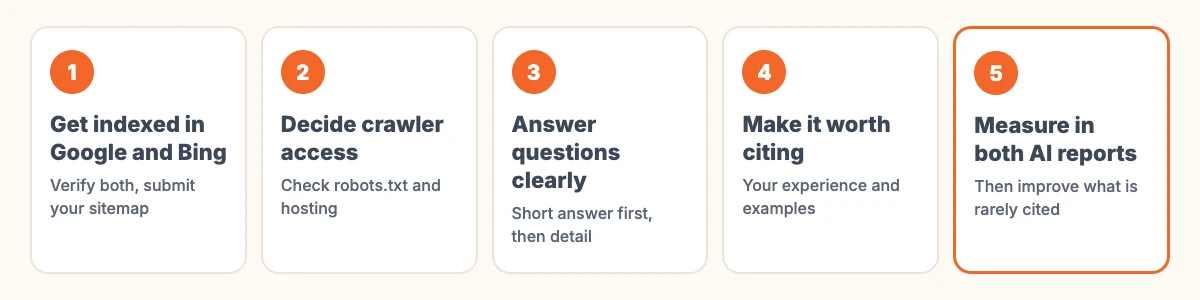
- Get indexed in both Google and Bing. Verify your site in Google Search Console and Bing Webmaster Tools, submit your sitemap, and fix crawl errors.
- Decide crawler access deliberately. Read your
robots.txtand check your hosting or CDN settings. Blocking by accident is common. - Answer questions clearly. Put a short, direct answer under each question heading, then the detail. Do not bury key facts in tabs, accordions, images or PDFs.
- Make the content worth citing. Add what only you can: your experience, your own data, real examples. Google’s guide names this “non-commodity” content as the thing most likely to matter over time.
- Measure in both AI reports. Check which pages are cited and which questions trigger them. Improve the pages that are indexed but rarely cited, which is also Bing’s suggestion.
We went deeper on the Google side in how to get featured in Google AI Overviews. If you plan to use AI tools to write at scale, read does Google penalize AI content? first, because mass-produced pages are the quickest way to undo all of the above.
Do you need separate SEO, AEO and GEO services?
Usually not. Most of the work is shared: technical health, clear content, real expertise, accurate business details. Google’s own advice for hiring SEO help now includes AEO and GEO. It suggests checking whether the advice is aligned with Google’s official guidance, and being wary of anyone who guarantees first place.
We list SEO, AEO and GEO as separate services ourselves, because buyers search for them separately and the reporting differs. Ask any provider, including us, the same things: exactly what will change on your site, which reports will show the result, and how long before you should expect to see it.
Separate effort makes sense in a few cases: a site already strong in SEO that now wants AI citations tracked and improved, or a business whose customers clearly ask detailed questions that AI tools answer. For a new or weak site, the money is better spent on the base. The SEO vs PPC question is often the more urgent one at that stage.
Frequently asked questions
What is the difference between GEO and SEO?
SEO aims to rank pages in search results and earn clicks. GEO aims to have your content used and cited inside AI-written answers. GEO depends on SEO, because AI features in Google and Bing draw on pages their search systems have already found and indexed.
Is GEO replacing SEO?
No. Google says optimising for its generative AI search is still SEO, and Microsoft calls traditional SEO “still essential”. AI answers have added a new place to appear, measured with new reports. They have not removed the need for crawlable, trusted pages.
What is AEO in simple words?
Answer engine optimisation means writing so a search engine or assistant can use your content as a direct answer to a question. Featured snippets and voice answers are the classic examples. It overlaps heavily with GEO, and many people use the two terms almost interchangeably.
How do I measure GEO results?
Use the Generative AI performance report in Google Search Console and the AI Performance report in Bing Webmaster Tools. Both show which of your pages are used in AI answers. Track enquiries alongside them, because citations without business results are not the goal.
Do I need a special AI file on my website for GEO?
Not for Google. Google says its Search does not use special AI text files and that they neither help nor harm your visibility there. Other services may treat them differently, so it is a low-priority choice rather than a requirement.
Sources
- Aggarwal et al., GEO: Generative Engine Optimization, first submitted 16 November 2023, revised 28 June 2024 (arXiv)
- Google, Optimizing your website for generative AI features on Google Search (published May 2026)
- Google, AI features and your website
- Google, Do you need an SEO?
- Google, New opportunities, control and insights for website owners (updated 31 August 2026)
- Microsoft Advertising, Optimizing your content for inclusion in AI search answers, October 2025
- Bing Webmaster Blog, Introducing AI Performance in Bing Webmaster Tools, 10 February 2026