Google Core Update 2026: What the November Update Means
Google core update 2026: the November update began on 10 November. What Google has confirmed, when to check Search Console and what to do if traffic fell.
Google’s November 2026 core update started rolling out on 10 November 2026 at 10:06 AM US Pacific time, which was 11:36 PM in India. Google’s Search Status Dashboard says it applies globally and to all languages, and that the rollout may take up to two weeks. Core updates are broad changes to how Google ranks pages; they do not target particular sites. If your traffic moved, Google’s advice is to wait until the rollout is complete, then wait at least another full week before comparing Search Console data. Small drops usually need no action; large, lasting drops call for a careful review of your most affected pages.
This guide covers what Google has confirmed about the update, the other updates of 2026, how to read your data, and what to do if you lost traffic.
Last reviewed: 17 November 2026. When this was written, the dashboard showed no completion note for the rollout. Sources are at the end.
| November 2026 core update | What Google has said |
|---|---|
| Started | 10 November 2026, 10:06 AM US Pacific (11:36 PM IST) |
| Scope | “Applies globally and to all languages” |
| Rollout time | “May take up to 2 weeks to complete” |
| Status on 17 November | In progress; no completion note on the dashboard |
| What changed | No specifics published |
| When to check your data | At least one full week after the rollout completes |
What is the Google November 2026 core update?
Google describes core updates as significant, broad changes to its search algorithms and systems, made several times a year. They are not aimed at specific sites or pages. When Google reassesses how it ranks content in general, some pages rise, some fall, and many do not change.
For the November 2026 update, the dashboard entry says only this: Google “released the November 2026 core update, which applies globally and to all languages”, and “the rollout may take up to 2 weeks to complete.” Google did not publish a list of what changed. Anyone who tells you exactly what this update rewards is guessing.
It is the third core update of 2026, after the March and May core updates.
Google core update 2026: every update so far
Google lists confirmed ranking updates on its Search Status Dashboard. These are the 2026 entries, with the duration the dashboard shows for each:
| Update | Started | Rollout took |
|---|---|---|
| February 2026 Discover update | 5 February | 21 days, 17 hours |
| March 2026 spam update | 24 March | 19 hours, 30 minutes |
| March 2026 core update | 27 March | 12 days, 4 hours |
| May 2026 core update | 21 May | 11 days, 21 hours |
| June 2026 spam update | 24 June | 2 days, 1 hour |
| August 2026 spam update | 18 August | 2 days, 16 hours |
| September 2026 spam update | 24 September | 13 days, 16 hours |
| November 2026 core update | 10 November | In progress when this was written |
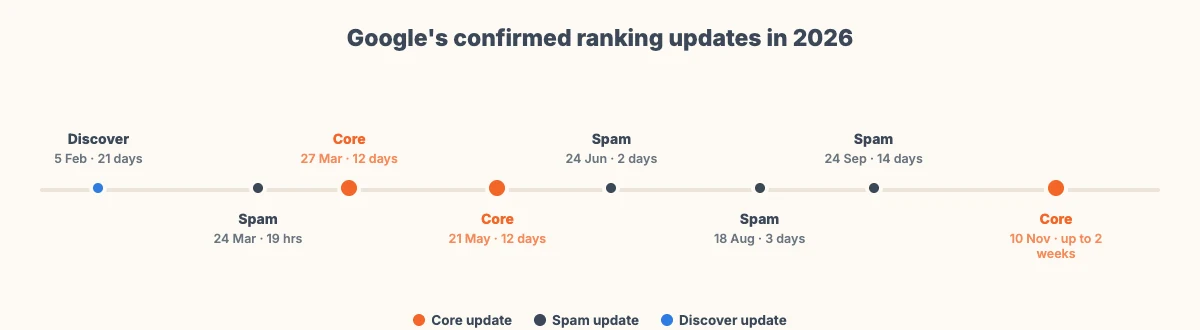
The earlier core updates this year took about twelve days to roll out, so a two-week window for November is in line with them. A spam update also finished in early October, so a drop you noticed in October is unlikely to be this core update.
Did the update affect my site?
Start by ruling out the other causes. Google’s guide to debugging traffic drops lists six: algorithmic updates, technical issues, security issues, spam issues, seasonality and changing interests, and site moves or migrations. A drop that began before 10 November cannot be this update.
Then check these in Search Console:
- Open the Manual actions report. If Google has taken manual action against your site, that is a separate problem from a core update and needs fixing first.
- Open the Security issues report. Google can show warnings to visitors before they reach a site with a detected threat, which cuts traffic on its own.
- Open the Page indexing report if the whole site dropped, to see whether pages fell out of the index for a technical reason.
- In the Performance report, compare the period after the change with an earlier one, and click through the queries, pages, countries, devices and search appearance tabs to see where the drop is concentrated.
- Sort the pages table by the difference in clicks to find the pages that lost the most.
Google suggests treating clicks and impressions as the main measures, and not reading too much into average position on its own.
When should I check my data?
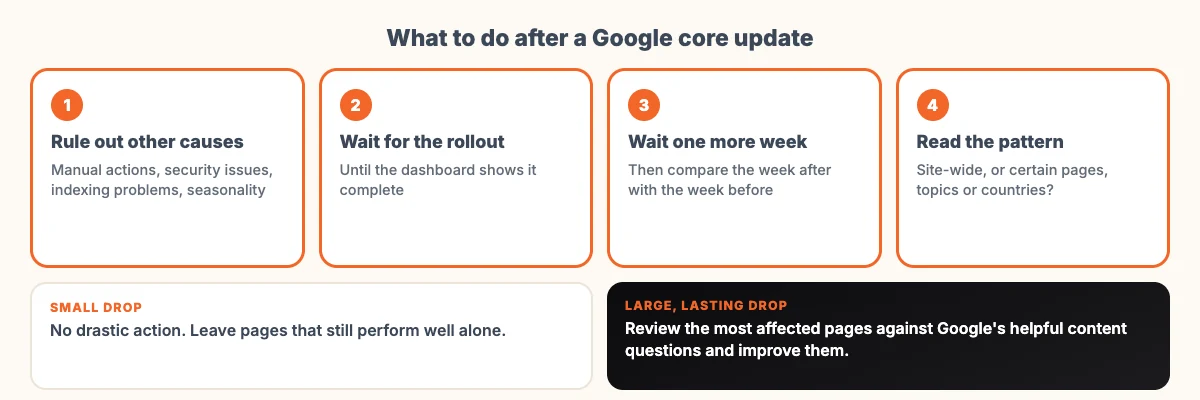
Google’s core update guidance says to wait until the rollout is complete, then wait at least a full week before analysing Search Console. After that, compare the week after the rollout with the week before it began. Checking in the middle of a rollout mostly shows noise.
| Step | What to look for |
|---|---|
| 1. Confirm the rollout finished | A completion note on the Search Status Dashboard entry for the November 2026 core update |
| 2. Wait at least one full week | Count from the completion date, not the start date |
| 3. Compare two weeks | The week after completion against the week before 10 November |
| 4. Look at the pattern | Is the change site-wide, or limited to certain pages, topics or countries? |
As an illustration only: if Google marked the rollout complete on 24 November, two weeks after it began, the earliest sensible comparison would use data from 1 December onwards. Use the actual completion date shown on the dashboard.
What should I do if I lost traffic?
Google separates small and large drops. For a small drop, its advice is not to take drastic action, and not to change content that is already doing well.
For a large drop that does not recover, Google suggests stepping back and assessing your whole site, then reviewing the most affected pages against its questions on helpful, people-first content. A few of those questions, quoted from Google’s guide:
- “Does the content provide original information, reporting, research, or analysis?”
- “Is this the sort of page you’d want to bookmark, share with a friend, or recommend?”
- “Does your site have a primary purpose or focus?”
- “Will someone reading your content leave feeling like they’ve had a satisfying experience?”
Google also asks site owners to think about who created the content, how it was made, and why. It calls the last question “perhaps the most important”: content should be made mainly to help people, not to attract search visits.
One way to run that review: take your ten most affected pages. For each one, search the query it used to rank for and read the pages that now rank above it. Ask what they answer that yours does not, whether your facts are current, and whether a visitor can tell who wrote your page and why they should trust it. Fix those things page by page.
What not to do after a core update
- Do not delete pages or page elements because of a rumour about what the update targeted. Google specifically warns against superficial changes made for that reason.
- Do not rewrite pages that are still performing well.
- Do not judge the result while the rollout is still running.
- Do not buy links or mass-produce pages to make up the traffic. Google’s spam policies list both, as link spam and scaled content abuse, and say such sites “may rank lower in results or not appear in results at all.”
If you use software to help write pages, Google’s helpful content guidance asks how the content was made and suggests a disclosure where readers would reasonably expect one. We covered Google’s view of machine-written content in more detail in our guide on whether Google penalises it.
How long does recovery take?
Google says some changes can take effect within a few days, but it can take several months for its systems to learn and confirm that a site is consistently helpful. If improvements show no effect after a few months, the change may only show at the next core update. There are usually several a year: this year there were core updates in March, May and November.
Because of that timescale, make changes you would keep anyway: a page rewritten only to chase this update may not be judged until the next one.
Getting help with a traffic drop
If the review points to deeper problems, such as thin pages across a whole section, a slow or broken site, or an old migration that lost redirects, the fix is usually a mix of content and technical work. Our SEO services and content writing pages explain how that work is usually planned, and website development covers the technical side.
For the wider picture of how Google’s generative answers choose sources, see how to get featured in Google’s answer summaries and GEO vs SEO vs AEO. If a drop followed a redesign rather than an update, our older guide to redesigning a website without losing SEO covers what to check.
Frequently asked questions
When did the Google November 2026 core update start?
On 10 November 2026 at 10:06 AM US Pacific time, which was 11:36 PM India time. Google’s Search Status Dashboard says the rollout may take up to two weeks to complete.
What did the November 2026 core update change?
Google has not published specifics. Its dashboard says only that the update applies globally and to all languages. Core updates are broad changes to Google’s ranking systems and do not target particular sites.
How many core updates has Google released in 2026?
Three, according to the Search Status Dashboard: in March, May and November. There were also spam updates in March, June, August and September, and a Discover update in February.
When should I check Search Console after a core update?
Google recommends waiting until the rollout is complete, then at least a full week more, and comparing the week after the rollout with the week before it began.
How long does it take to recover from a core update?
Google says some changes take effect in a few days, but it can take several months for its systems to confirm a site is consistently helpful, and sometimes the change only shows at the next core update.
Sources
- Google Search Status Dashboard, November 2026 core update (checked 17 November 2026)
- Google Search Status Dashboard, ranking incident history
- Google Search Central, Google Search’s core updates
- Google Search Central, Debugging drops in Google Search traffic
- Google Search Central, Creating helpful, reliable, people-first content
- Google Search Central, Spam policies for Google web search