IT Rules 2026: AI Content Labelling Guide for Marketers
India's IT Rules 2026 require labels on realistic AI audio, images and video. Learn what counts as SGI, what is excluded and what marketers should do now.

India’s IT Rules amendment of 2026 requires AI-made audio, images and video that look real to be labelled, and it took effect on 20 February 2026. The rules call this content “synthetically generated information” (SGI). Most of the legal duties fall on platforms such as social media sites, which must label SGI and, for the largest ones, ask users to declare it before publishing. For a marketer, three things matter most: text alone is not SGI, routine editing does not count, and anything realistic that you generate should be declared honestly when a platform asks.
This guide explains what the rules cover, what they leave out, and what marketing and social media teams should do differently. It is general information, not legal advice.
Last reviewed: 7 November 2026. Based on MeitY’s FAQ on the amendment and the notified rules; links at the end.
What are the IT Rules 2026 on AI content?
The Information Technology (Intermediary Guidelines and Digital Media Ethics Code) Amendment Rules, 2026 were notified on 10 February 2026 (G.S.R. 120(E)) and came into force on 20 February 2026. They amend the IT Rules, 2021, which set out what “intermediaries” such as social media platforms, video sites and messaging services must do.
MeitY’s FAQ summarises the main changes: a definition of SGI with specific exclusions, a due diligence framework for platforms that host or help create it, extra duties for Significant Social Media Intermediaries, and much shorter deadlines for removing unlawful content.
What counts as synthetically generated information?
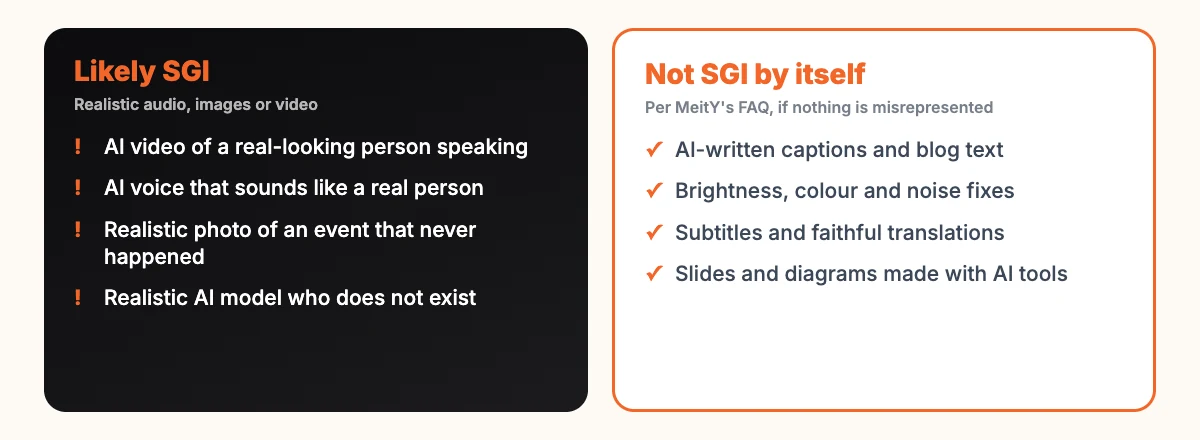
Under Rule 2(1)(wa), SGI is audio, visual or audio-visual information created or altered using a computer resource in a way that makes it appear real, and that shows a person or event in a way likely to be seen as indistinguishable from a real person or real-world event.
Two parts of that definition do most of the work for marketers:
- It covers audio, images and video. MeitY’s FAQ states that pure text or written outputs, by themselves, are not SGI.
- It covers content made to look real. A clearly cartoon-style illustration is a different case from a realistic photo of a person who never posed for it.
What is not SGI?
MeitY’s FAQ lists exclusions so that ordinary work is not caught. Each applies only if the result does not mislead or misrepresent:
| Exclusion | Examples given in MeitY’s FAQ |
|---|---|
| Routine, good-faith editing or enhancement | Brightness, contrast or sharpening without changing what the photo shows; compressing a video; removing background noise; stabilising a shaky video; colour correction; transcribing an interview |
| Routine creation of documents and materials | Slide decks made with templates or AI design tools; illustrative diagrams and flowcharts; hypothetical case studies for training |
| Accessibility, clarity and translation | Subtitles and captions; translating a speech without changing its meaning; auto-generated summaries or tags; audio descriptions |
The second exclusion stops where documents become false records. MeitY’s FAQ is clear that forged certificates, fake IDs or fabricated electronic records fall outside it.
Who has to do what?
The rules place most duties on platforms rather than on the businesses that post there. That still affects you, because the platforms pass some of it on to users.
| Who | Main duties under the 2026 amendment |
|---|---|
| Platforms that host or help create SGI | Use reasonable technical measures to prevent unlawful SGI. Label permissible SGI prominently on screen, or with a spoken notice at the start of audio, and embed permanent metadata or a provenance marker with a unique identifier where technically feasible. Tools that create SGI should not offer features such as “remove watermark” or “export without metadata”. |
| Significant Social Media Intermediaries | Before publishing, ask users to declare whether content is SGI, use technical measures to check the declaration, and label content confirmed as SGI prominently. |
| All intermediaries | Remove unlawful content within 3 hours of a court order or a reasoned notice from an authorised government officer, down from 36 hours. Remove certain complained-of content, such as non-consensual intimate or morphed images, within 2 hours of a complaint, down from 24. |
| Users, including brands | Answer platform declarations truthfully, follow platform labelling, and keep away from prohibited categories of synthetic content. |
MeitY gives a worked example of the 3-hour rule: a notice about a deceptive SGI video received at 11:00 AM must be acted on by 2:00 PM at the latest.
Does this post need a label? Seven common cases
These are our readings of everyday marketing situations against MeitY’s definition and exclusions. They are a starting point for your team, not a legal opinion, and the platform’s own rules may ask for more.
| Situation | Likely SGI? | Why |
|---|---|---|
| AI-written caption, blog post or ad copy | No | Pure text is not SGI under MeitY’s FAQ. |
| Product photo with brightness, colour and background noise cleaned up | No | Routine editing is excluded, as long as the product looks as it really is. |
| Ad video with AI-generated subtitles in Hindi and Tamil | No | Subtitles and faithful translation are listed exclusions. |
| Realistic AI-generated model wearing your product, who does not exist | Likely yes | It is a realistic image of a person who appears real. Declare it when the platform asks. |
| Voiceover in a cloned voice of your founder | Likely yes | Audio made to sound like a real person. Get the founder’s written consent and declare it. |
| Realistic AI photo of a packed store launch that never happened | Yes, and misleading | It shows an event that did not occur as if it were real. Do not publish it. |
| Clearly animated explainer with cartoon characters | Probably not | The definition covers content made to appear real. If the animation could pass for real footage, treat it as SGI. |
A useful test when a case is unclear: would an ordinary viewer believe this person said it, or this event happened? If yes, treat it as SGI and declare it.
Questions to ask your agency
- Which of the creatives you deliver use AI-generated people, voices or realistic scenes?
- Do you keep the original files and the metadata your tools add?
- Do you have consent in writing for any real person’s likeness or voice you have recreated?
- Who on your side answers a platform’s synthetic content declaration when you post on our behalf?
The answers tell you quickly whether your agency has thought about this. Clear written answers also protect both sides if a post is questioned later.
What should marketers do now?
Most changes are small habits. Use this as a checklist for your team or agency.
- Keep a simple log of which creatives used AI generation for faces, voices or realistic scenes, and which tool made them.
- When a platform asks whether content is AI-generated or synthetic, answer honestly. The declaration is how the largest platforms decide what to label.
- Do not strip labels, watermarks or metadata from AI-generated media. The FAQ treats tools that remove them as undermining SGI identification.
- Get written consent before creating a realistic likeness or voice of a real person, including your own staff, founders or brand ambassadors.
- Avoid realistic AI scenes of events that never happened in ads or posts, such as a crowd at a store opening that did not take place.
- Treat AI-written captions, blog posts and ad copy like any other copy: check the facts. Text is not SGI, but a misleading claim is still misleading, whoever or whatever wrote it.
- Brief your agencies and freelancers. If they produce your creatives, they should follow the same rules.
For the search side of AI-written text, we covered Google’s view in does Google penalize AI content? And if you are planning campaigns around AI-made creatives, our digital marketing and social media marketing pages explain how that work is usually planned. Our older note on generating leads through content marketing is a reminder that most of the work is still ordinary, honest content.
How to spot and report a deepfake of your brand
The same technology that makes ad production cheaper also makes impersonation easier. Watch for:
- videos or voice notes of your founder or staff saying things they never said;
- fake “offers” or job adverts using your logo and a realistic AI spokesperson;
- customers asking about calls or messages your team did not send.
If you find one, report it to the platform first, using its impersonation or synthetic media option, and keep screenshots, links and dates. For cyber fraud, India’s National Cyber Crime Reporting Portal takes complaints online. Tell your customers through your own official channels which numbers and accounts are genuine. Industry provenance standards such as C2PA aim to make the origin of genuine media easier to check over time.
Frequently asked questions
When did the IT Rules 2026 on AI content come into force?
The amendment was notified on 10 February 2026 as G.S.R. 120(E) and came into force on 20 February 2026, according to MeitY’s FAQ.
Is AI-written text covered by the labelling rules?
No. MeitY’s FAQ says pure text or written outputs, by themselves, are not synthetically generated information, because SGI covers audio, visual and audio-visual content. Text used to commit an unlawful act alongside synthetic media can still be relevant.
Do I need to label photos I edited with AI tools?
Not for routine, good-faith edits such as brightness, contrast, sharpening, colour correction or noise removal, provided they do not change what the photo shows or mislead. A realistic image of something that did not happen is different.
Who is responsible for labelling AI content in India?
Mainly the platforms. They must label permissible SGI and, for the largest platforms, collect user declarations before publishing. Users, including brands, are expected to declare honestly and follow platform labelling.
How quickly must platforms remove deepfakes in India?
Within 3 hours of a court order or a reasoned notice from an authorised government officer, and within 2 hours of a complaint for certain categories such as non-consensual intimate or morphed images, according to MeitY’s FAQ.
Sources
- MeitY, Frequently Asked Questions on the IT (Intermediary Guidelines and Digital Media Ethics Code) Amendment Rules, 2026 (PDF)
- MeitY, Amendment Rules, 2026, G.S.R. 120(E), 10 February 2026 (PDF)
- PIB, Government strengthens regulatory framework to address AI-generated deepfakes
- National Cyber Crime Reporting Portal
- C2PA, Coalition for Content Provenance and Authenticity