Agentic Commerce Explained: Get Your Online Store Ready
Agentic commerce lets AI agents shop and pay for customers. See what is live in 2026, where India stands with UPI, and how to get your store ready.

Agentic commerce means an AI agent shopping on a person’s behalf: finding a product, comparing options and, with permission, paying for it. In 2026 it is real but early. Google’s Universal Commerce Protocol lets selected merchants sell directly inside its AI search in the United States, and in India, NPCI and Razorpay have tested UPI payments that an AI assistant can make within limits the user sets. For most stores, the sensible step today is small: get product data, prices, stock and policies clean and accurate, because that is what an agent reads.
Last reviewed: 7 November 2026. This area is moving quickly, so check the dated sources at the end.
What is agentic commerce?
Today, an AI assistant can already recommend a product. Agentic commerce goes one step further: the assistant completes the purchase. Visa described the idea in April 2025 when it launched Visa Intelligent Commerce, saying AI agents would find, shop and buy for consumers based on their preferences, with each consumer setting the limits.
Finding and paying for a product is the easy part; trust is harder. A store needs to know the order is genuine, a bank needs proof the person approved the payment, and the shopper needs to know the agent will not overspend. Most of the work happening now is on that plumbing.
How does it work?
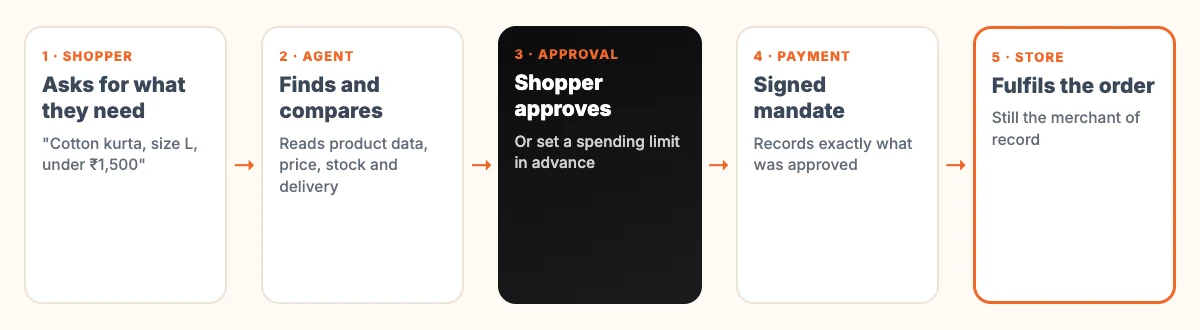
Three open standards are shaping how the pieces connect:
- Universal Commerce Protocol (UCP). An open-source standard that Google described in January 2026, developed with Shopify, Etsy, Wayfair, Target and Walmart, and endorsed by more than 20 other companies including Flipkart, Mastercard, Visa and Stripe. It lets an agent discover what a store sells and complete a checkout. Its specification says businesses remain the merchant of record, with full ownership of customer relationships.
- Agent Payments Protocol (AP2). Announced by Google in September 2025 with more than 60 organisations. It uses “mandates”: tamper-proof, cryptographically signed records of what a person asked for and approved. When you approve a cart, AP2 records the exact items and price, so what you see is what you pay for.
- Agent-to-agent and tool protocols. UCP also supports integration through Agent2Agent (A2A) and the Model Context Protocol (MCP), which are ways for AI systems to talk to each other and to business tools.
You do not need to understand the specifications. The industry is building shared rules, so each assistant does not need its own checkout. Shared rules usually mean that, later on, an ecommerce platform can add support once and many stores benefit.
What is live, and what is only announced?
| Development | Date | Status when we checked |
|---|---|---|
| Visa Intelligent Commerce | April 2025 | Announced as an initiative opening Visa’s network to developers building AI agents |
| Google Agent Payments Protocol (AP2) | September 2025 | Open protocol, developed with more than 60 organisations |
| Razorpay and NPCI agentic payments on UPI | October 2025 | Private beta with a leading AI assistant |
| Google Universal Commerce Protocol (UCP) | January 2026 | Early access. Merchant Center onboarding rolling out gradually in the United States, for products sold within the US; Australia and Canada to follow. Integrations need Google’s approval. |
| UCP for lodging and food | 2026 | Waitlist open when we checked |
So, as of November 2026, a typical Indian online store cannot simply switch on agent checkout in Google’s AI search. It is a good time to prepare cheaply and a poor time to spend heavily.
Where does India stand?
India has a head start on one piece: payments. On 9 October 2025, Razorpay announced a private beta of “Agentic Payments” built with NPCI, the organisation behind UPI, and a leading AI assistant. It uses two UPI features, UPI Circle and UPI Reserve Pay, so a user can pre-authorise a trusted AI agent to buy within spending limits they set, without entering a PIN for each purchase.
In the demonstration, people could browse and check out from bigbasket inside a chat, and recharge a mobile plan through the Vi app. Razorpay named Axis Bank and Airtel Payments Bank among the supporting banks. It is a beta, not a nationwide service, but it shows how agentic payments might look in India: built on UPI, with limits the customer controls.
Flipkart is among UCP’s endorsers, so Indian sellers have reason to follow the standard even though the first rollout is in the US.
What should an online store do now?
An agent can only buy what it can understand. Everything on this list helps today as well, with search, marketplaces and human shoppers.
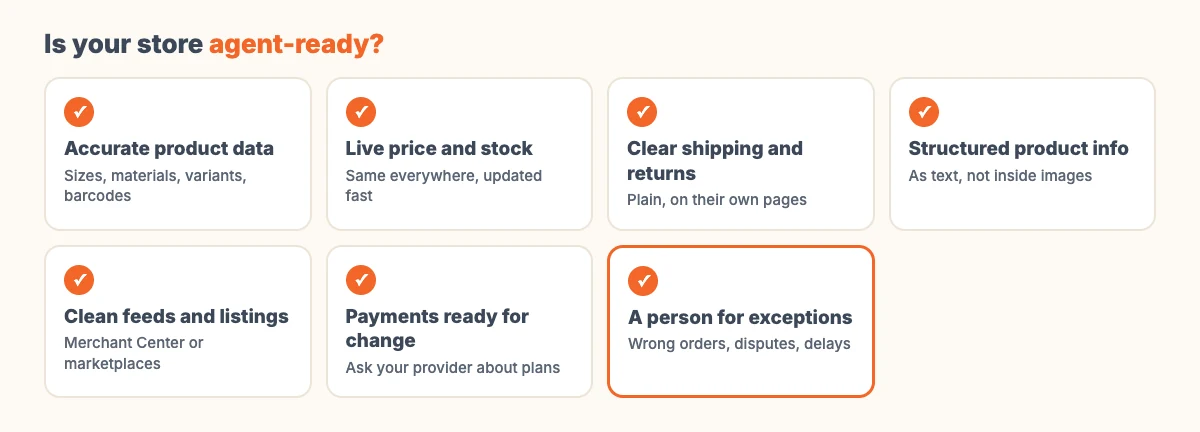
| Area | What “ready” looks like |
|---|---|
| Product data | Full names, sizes, materials, variants and identifiers such as GTIN or barcode, written so a machine can tell two similar products apart |
| Price and stock | The price on your site, in your feed and at checkout always matches; out-of-stock items are marked within minutes, not days |
| Policies | Shipping areas, delivery times, return and refund rules written plainly on their own pages |
| Structured information | Product details marked up correctly, and visible on the page, not only inside images |
| Feeds and listings | A Google Merchant Center account in good standing, or clean marketplace listings; Google says AI responses can include product listings and that Merchant Center feeds help |
| Payments | A payment provider that is following agentic payments and can add new methods without a rebuild |
| Exceptions | A person who handles wrong orders, failed deliveries and disputes quickly |
If you can tick most of these, you are ahead of many stores, agents or not. Our older checklist of key factors for a successful ecommerce website covers the human side of the same ground, and our guide on getting featured in Google AI Overviews explains how Google’s AI search finds pages in the first place.
One product, two listings
An illustration with a made-up store shows what “clean product data” means in practice. Imagine a shopper asks an assistant: “Find a pure cotton kurta for a man, size L, under ₹1,500, that can reach Noida by Friday.”
| Detail | Weak listing | Agent-ready listing |
|---|---|---|
| Title | Stylish Kurta – Best Quality!! | Men’s Straight Kurta, 100% Cotton, Indigo, Full Sleeves |
| Fabric | “Premium fabric” in an image | 100% cotton, written as text |
| Size | “All sizes available” | S, M, L, XL, each with chest measurement and live stock |
| Price | ₹1,499 on the page, ₹1,599 in the feed | ₹1,499 everywhere, including at checkout |
| Delivery | “Fast delivery” | Delivery estimate by PIN code, shown before checkout |
| Returns | Not stated | 7-day returns, size exchange free, link to the policy page |
A person might still buy from the weak listing after a few questions on WhatsApp. An agent working for that person has no one to ask. It can only match what is written, so the agent-ready listing is the one it can recommend with confidence. The figures are for illustration only; the pattern to copy is specific, consistent facts a machine can read.
Fixing this costs time more than technology. Start with your 20 best-selling products, fix their titles, attributes, sizes and policies, check that the price matches everywhere, and then work through the rest of the catalogue.
What not to spend on yet
- Custom agent integrations for platforms you cannot access. Google’s UCP onboarding is early access and US-first. Wait until your platform or payment provider supports it.
- Tools that promise “AI shopping visibility” scores. Google says no third-party tool has access to its ranking or AI systems, and the same caution applies here.
- Your own shopping agent, unless you are a large retailer with a clear reason. In our view, most customers will use the assistants they already have.
A sensible middle step is to ask your ecommerce platform and payment provider one question: “What is your plan for UCP and agentic payments?” Google’s own guide suggests exactly that for merchants using a third-party platform.
What are the risks?
Agentic commerce shifts some decisions from people to software, and that creates new kinds of trouble:
- Wrong orders. An agent may pick the wrong size or variant if your data is unclear. Clear product data is your best defence.
- Disputes. Customers may say “I didn’t mean to buy that”. Mandates are designed to record what was approved, but expect a learning period for banks, stores and customers.
- Responsibility. UCP keeps the store as merchant of record, so delivery, returns and customer care remain yours. Plan for that rather than assuming the platform handles it.
- Agents acting on bad information. We covered how AI agents can make costly mistakes, and how to limit them, in what AI agents can really do for a small business.
You do not have to wait for everything to settle. Build on data you control and move when your platform does. If your store needs that groundwork, our ecommerce website development page explains how a rebuild or clean-up is usually scoped, and our SEO services page covers the product visibility side. For a broader view of where online selling has been heading, see our earlier piece on ecommerce trends.
Frequently asked questions
What is agentic commerce in simple words?
It is shopping done by an AI agent for a person. The agent finds and compares products and, with the person’s approval or within limits they set, completes the purchase. The store still sells and delivers the product.
What is Google’s Universal Commerce Protocol?
UCP is an open-source standard that lets AI agents discover what a store sells and complete a checkout. Google described it in January 2026, developed with Shopify, Etsy, Wayfair, Target and Walmart. Its early-access onboarding is rolling out gradually in the United States.
Is agentic commerce available in India?
Partly. Google’s UCP checkout is US-first for now. On payments, Razorpay and NPCI ran a private beta in October 2025 that lets an AI assistant pay through UPI within limits the user sets, using UPI Circle and UPI Reserve Pay.
How can a small online store prepare for AI shopping agents?
Keep product data detailed and accurate, keep prices and stock in sync everywhere, write clear shipping and returns policies, use a Merchant Center or marketplace feed, and ask your platform and payment provider about their plans. All of this also helps with ordinary search.
Who is responsible if an AI agent orders the wrong product?
Under UCP, the store remains merchant of record, so delivery, returns and customer care stay with the store. Payment protocols such as AP2 record what the customer approved, which should help settle disputes. Expect the rules to develop as more purchases happen this way.
Sources
- Google Developers Blog, Under the hood: Universal Commerce Protocol, 11 January 2026
- Google Merchant, Getting started with UCP and UCP integration guide (eligibility)
- Universal Commerce Protocol specification site
- Google Cloud Blog, Agent Payments Protocol (AP2), 17 September 2025
- Visa, Visa Intelligent Commerce press release, 30 April 2025
- Razorpay, Agentic Payments private beta with NPCI, 9 October 2025
- Google, Optimizing your website for generative AI features on Google Search