Flutter vs React Native: Which Is Better in 2026?
Flutter vs React Native in 2026: how each builds your app, platforms, speed, hiring and cost, plus a simple guide to which one suits your business.
Flutter vs React Native comes down to how each one builds the screen and which skills your team already has. Both let you build an Android and an iOS app from one codebase. Flutter, from Google, uses the Dart language and draws its own interface with its own rendering engine, so the app looks the same on every device and the same code can also target web, Windows, macOS and Linux. React Native, from Meta, uses JavaScript and React and turns your code into the phone’s own native interface parts. Pick React Native if your team already works in React or you have a React website to share code and people with. Pick Flutter if you want a highly custom design that looks identical everywhere, or plan desktop and web versions from the same code. Neither is better for every app.
This guide compares the two on the points that decide a real project: how they work, platforms, speed, the 2026 changes, hiring, cost and when to choose which.
Last reviewed: 17 November 2026. Versions checked: Flutter 3.50 and React Native 0.88. Sources are at the end.
What are Flutter and React Native?
Flutter describes itself as “an open-source framework for building beautiful, natively compiled, multi-platform applications” from a single codebase. Its site says it is “supported and used by Google” and maintained with a global developer community, and that it “is powered by Dart”. Apps in Flutter’s own showcase include Google Pay, Toyota, Zoho Tables and Dream11, which the page describes as supporting 50 million fantasy sports users in India.
React Native’s tagline is “Learn once, write anywhere.” Its site says it is “written in JavaScript, rendered with native code”, and that Meta released it in 2015 and has maintained it since, with contributions from companies such as Microsoft, Expo and Software Mansion. Apps shown on its home page include Flipkart, Microsoft Teams and Discord.
Flutter vs React Native: side-by-side comparison
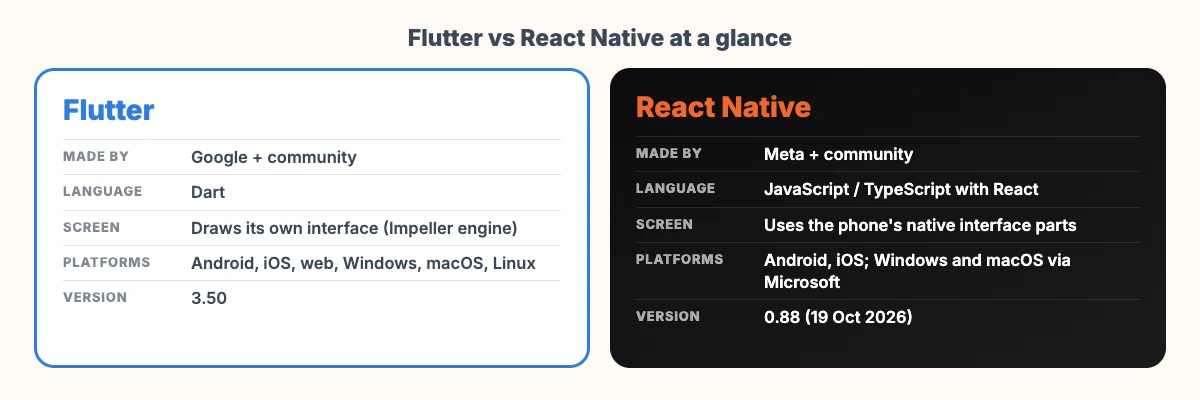
| Point | Flutter | React Native |
|---|---|---|
| Made by | Google, with the community | Meta, with the community |
| Language | Dart | JavaScript or TypeScript, with React |
| How the screen is drawn | Flutter draws its own interface with its Impeller rendering engine | React components map to the platform’s native interface building blocks |
| Official platforms | Android, iOS, web, Windows, macOS, Linux | Android and iOS; Windows and macOS through Microsoft’s partner projects, plus other partner and community platforms |
| How to start a new app | Flutter SDK | The React Native docs recommend a framework such as Expo |
| Latest stable version checked | 3.50 | 0.88 (19 October 2026) |
| Examples from official pages | Google Pay, Dream11, Toyota | Flipkart, Microsoft Teams, Discord |
How does each one put your app on screen?
Flutter paints every button, list and animation itself. Its documentation describes Impeller as a rendering runtime that precompiles a smaller, simpler set of shaders when the engine is built, so they do not compile while the app runs. Impeller has been the default on iOS and on Android API 29 and above since Flutter 3.27, and on Windows, macOS and Linux since 3.47. On older Android devices or those without Vulkan, Flutter falls back to its older OpenGL renderer. Because Flutter draws everything, a design looks the same on a Samsung phone and an iPhone, which suits brands with a strong custom look.
React Native takes the other route. Its core components, such as View, Text and Image, map to the platform’s own interface building blocks, so a React Native app uses the same native controls as other apps on that phone. Screens can feel familiar to Android and iPhone users and follow each platform’s conventions with less effort.
Which is better: Flutter or React Native?
It depends on your team, your design and where else the app needs to run. These are common situations and the usual fit for each.
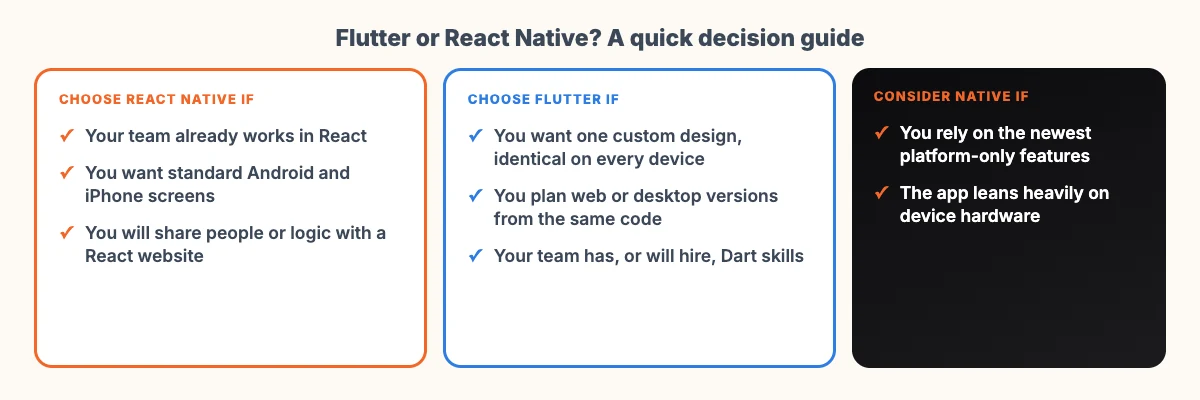
| Your situation | Usually the better fit | Why |
|---|---|---|
| Your developers already build websites in React | React Native | Same language and way of thinking; skills and some logic carry over |
| You want a highly custom, brand-heavy design that looks identical on every phone | Flutter | Flutter draws its own interface, so it does not depend on each platform’s controls |
| You want the app to look and behave like a standard Android or iPhone app | React Native | It uses the platform’s native interface components |
| You also want desktop or web versions from the same code | Flutter | Web, Windows, macOS and Linux are official Flutter targets |
| You are starting with no in-house team and will hire an agency | Either | Choose the team with a strong record in one of them, not the framework alone |
| The app depends heavily on one platform’s newest features | Consider native | Both can call native code, but a native app works directly with each platform’s own tools |
What about performance?
Both frameworks are used for large production apps, as the examples above show, and both have done serious performance work. Flutter’s Impeller precompiles its shaders to avoid compiling them while the app runs. React Native 0.82, released in October 2025, was described by the React Native team as “the first React Native that runs entirely on the New Architecture”, and React Native 0.84, in February 2026, made Hermes V1 the default JavaScript engine, which the team said brings “significant performance improvements to all React Native apps.”
We have not found an independent benchmark that settles which is faster for business apps, and published comparisons often test one narrow case. In practice, speed depends more on how the app is built: image sizes, list handling, the number of network calls and the work done on startup. Whichever you choose, test on low-cost Android phones, not only on the newest models, because that is where problems show first.
What changed in Flutter vs React Native in 2026?
- React Native 0.84 (February 2026) made Hermes V1 the default engine and continued removing the Legacy Architecture on iOS and Android.
- React Native came to Meta Quest headsets, announced on its blog in February 2026.
- React Native 0.88 (19 October 2026) moved to React 19.3 and was released with no breaking changes, according to its release post.
- Flutter 3.47 made Impeller the default renderer on Windows, macOS and Linux.
- Flutter 3.50 is the current stable release. Its platform page says support for Intel-based Macs is being phased out, with macOS Tahoe (26) as the final macOS version for those machines.
For a business, the practical point is that both frameworks are actively maintained and updated several times a year, so budget for keeping your app on a supported version.
Is it easier to hire Flutter or React Native developers?
We have not found reliable official data on demand or salaries for Flutter and React Native developers in India, so we will not quote numbers. What we can say is how each choice affects hiring:
- React Native uses JavaScript and React. If you already have React web developers, they can learn React Native, and you can also hire from among React developers.
- Flutter uses Dart. Your team will need Dart skills, so check the experience of the people who will work on your app.
- For either, ask to see apps the team has released on the Play Store and App Store, and ask who will maintain the app after launch.
Does one cost less to build?
Both save money in the same way: one codebase for Android and iOS instead of two separate native apps. Beyond that, cost depends on features, design, backend work and testing, not on the framework. Our guide to app development cost in India explains what drives the price and the store fees you will pay either way.
One cost difference can show up later. If you already run a React website, React Native can let one team look after both. If you plan desktop and web versions, Flutter can cover them from the same code. Both of these can lower the cost over a few years more than the first build.
When is neither the right choice?
Cross-platform frameworks are not the answer for every app. A fully native app, written separately for Android and iOS, can make sense when the app relies on the newest platform-only features, heavy device hardware use, or very specific platform behaviour. Our older note on native versus hybrid apps covers that choice. If all you need is a simple information app, a well-built mobile website may be enough to start with.
Getting your app built
Our Flutter app development and React Native app development pages explain how a project in each framework is usually scoped, and mobile app development covers native apps and the wider process. Whichever framework you choose, clear screens matter as much as the code, as our piece on designing an intuitive interface for a mobile app explains.
Frequently asked questions
Which is better, Flutter or React Native?
Neither is better for every app. React Native suits teams that already know React and apps that should look like standard Android and iPhone apps. Flutter suits highly custom designs that must look identical everywhere and apps that also need web or desktop versions from the same code.
Is Flutter faster than React Native?
There is no single answer. Flutter’s Impeller engine precompiles its shaders, and React Native now runs on its New Architecture with Hermes V1 as the default engine. Real speed depends mostly on how the app is built, so test on low-cost phones whichever you choose.
Which companies use Flutter and React Native?
Flutter’s showcase lists apps including Google Pay, Dream11 and Toyota. React Native’s home page shows apps including Flipkart, Microsoft Teams and Discord.
Which language does each one use?
Flutter uses Dart. React Native uses JavaScript or TypeScript with React, so web developers who know React can learn it faster.
Can Flutter and React Native build web and desktop apps?
Flutter officially supports web, Windows, macOS and Linux as well as Android and iOS. React Native’s core targets are Android and iOS, with Windows and macOS available through Microsoft’s partner projects and web through a community project.
Sources
- Flutter, official site
- Flutter docs, Supported deployment platforms (as of Flutter 3.50)
- Flutter docs, Impeller rendering engine (updated 21 August 2026)
- Flutter docs, Release notes (updated 11 November 2026)
- Flutter, App showcase
- React Native, official site
- React Native blog, release posts 0.82 to 0.88
- React Native docs, Get started (framework recommendation)
- React Native docs, Out-of-tree platforms