Google Ads vs Meta Ads: Which Is Better for Your Business?
Google Ads vs Meta Ads explained simply: where each shows your ads, how the auctions and budgets work, and which one suits your business first.
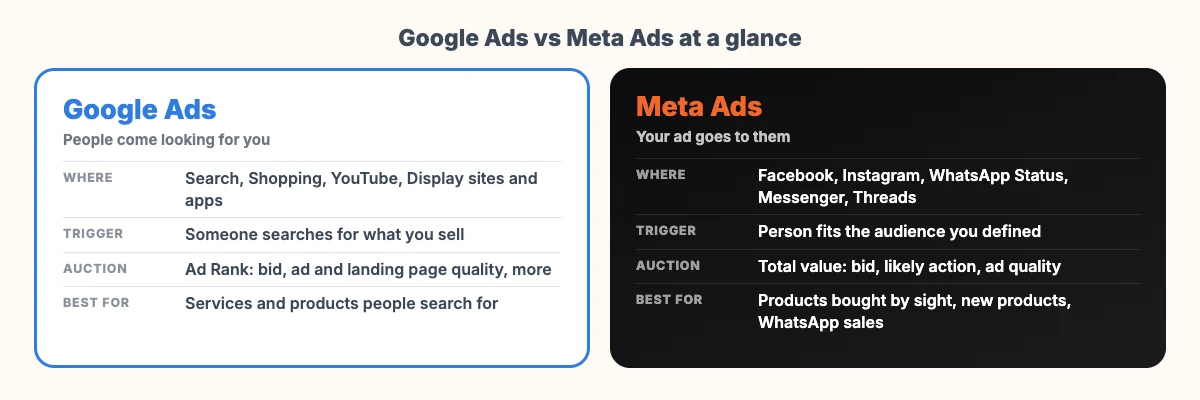
Google Ads vs Meta Ads is really a choice between two moments in a customer’s day. Google’s search ads appear when someone types a query on Google, so they reach people who are already looking for what you sell. Meta ads appear while people scroll Facebook, Instagram, WhatsApp Status, Messenger or Threads, and reach the audience you define, often before they knew they wanted your product. Neither is better on its own. Google usually suits services and products people actively search for, such as “AC repair near me” or “CA firm in Noida”. Meta usually suits products people buy on impulse or by sight, offers you want to show to a defined audience, and getting enquiries on WhatsApp. Many businesses run both, with different jobs.
This guide explains how each platform works, how you pay, how budgets behave, and how to decide where your first rupee should go.
Last reviewed: 20 November 2026. Based on Google Ads Help and Meta Business Help Centre; links are at the end.
Google Ads vs Meta Ads: how are they different?
On Google, people come looking for you; on Meta, your ad goes to them.
Google describes its Search campaigns as “text ads on search results”. Its other campaign types reach people elsewhere: Display ads across websites, apps and Google properties such as YouTube, Video campaigns on YouTube, Shopping ads that “appear on search results and the Google Shopping tab”, App campaigns, and Performance Max, which Google calls “a goal-based campaign type” that can use all Google Ads inventory from one campaign.
Meta says that, depending on the objective you choose, “your ads can appear on Facebook, Messenger, Instagram, WhatsApp, Threads and Meta Audience Network.” The placements include Facebook and Instagram feeds, Stories, Reels, WhatsApp Status, Marketplace, search results inside Facebook and Instagram, and apps in Meta’s Audience Network. Advertisers choose who sees the ads by defining a target audience.
| Point | Google Ads | Meta Ads |
|---|---|---|
| Where ads appear | Google Search, Shopping, YouTube, Display network sites and apps, and other Google properties | Facebook, Instagram, Messenger, WhatsApp, Threads and Meta Audience Network |
| How people find you | They search for something; your search ad matches the query | They are scrolling; your ad reaches the audience you defined |
| Main ad formats | Text ads, Shopping ads, video and display ads | Ads in feeds, Stories, Reels, WhatsApp Status and other placements |
| Who wins the auction | Ad Rank: bid, ad and landing page quality, and other factors | Highest “total value”: bid, estimated action rate and ad quality |
| Goals you can choose | Campaign types such as Search, Performance Max, Shopping, Video, Display and App | Six objectives: Awareness, Traffic, Engagement, Leads, App promotion and Sales |
| Usually strongest for | People who already know what they need | Showing a product or offer to a defined audience, and enquiries on WhatsApp |
How do you pay on each platform?
Both run an auction every time there is a chance to show an ad, and on both, a higher bid alone does not guarantee a win.
On Google, your bid tells Google Ads “the maximum amount you’re willing to pay for a click on your ad”, and the amount you pay is called “your actual CPC”. Whether your ad shows depends on Ad Rank, which Google says is based on six factors: your bid, the quality of your ads and landing page, Ad Rank thresholds, the competitiveness of the auction, the context of the person’s search, and the expected impact of your ad assets and formats.
On Meta, the auction winner is the ad with the highest total value, which combines three things: your bid, an estimate of how likely that person is to take the action you want, and ad quality, judged partly from feedback such as people hiding the ad. Meta says that because relevance is part of the auction, “an ad that’s more relevant to a person could win an auction against ads with higher bids.”
The practical lesson is the same on both: a clear, relevant ad and a good landing page lower what you pay for each result. Throwing more money at a weak ad mostly buys expensive clicks.
How do budgets work?
Google publishes a precise rule for daily budgets. On a given day, a campaign can spend up to twice its average daily budget, but over a month you are never charged more than 30.4 times the daily budget, 30.4 being the average number of days in a month. Google’s help pages do not state a minimum budget.
| Average daily budget (illustration) | Most Google can spend in one day | Most you can be charged in a month |
|---|---|---|
| ₹500 | ₹1,000 | ₹15,200 |
| ₹1,000 | ₹2,000 | ₹30,400 |
| ₹3,000 | ₹6,000 | ₹91,200 |
The budgets in this table are examples; the limits follow Google’s 2x daily and 30.4x monthly rule for most campaigns.
Meta does not publish a single rule like this in the pages we checked. It recommends its Advantage+ placements so its delivery system can try to make the most of your budget, and notes that adding more placements “does not increase the cost of your ad.”
Whichever you use, check your invoices for how taxes are shown, and keep the GST details of your business updated in the ad account.
Google Ads vs Meta Ads: which is better for your business?
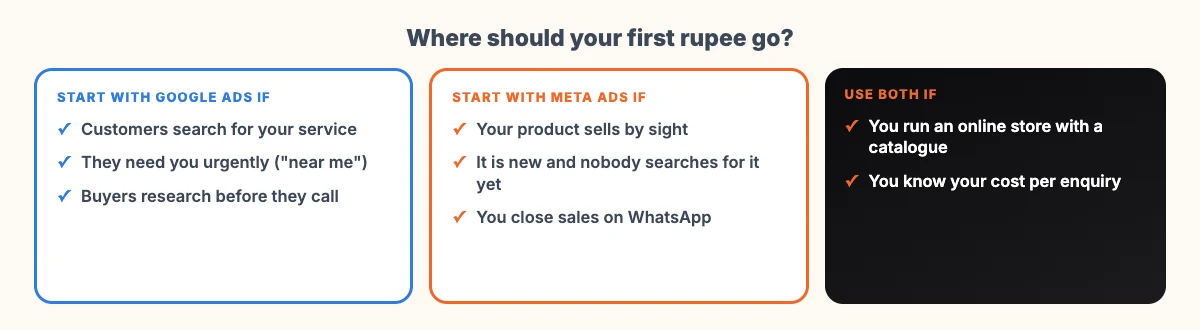
Start from how your customers buy.
| Your business | Usually start with | Why |
|---|---|---|
| Urgent local services: plumber, pest control, AC repair, clinic | Google Ads | People search when they need you, often with “near me” |
| B2B services people research: software, CA firm, industrial supplies | Google Ads | Buyers search for the service by name before they call |
| Fashion, food, décor, gifts and other products bought by sight | Meta Ads | Images and Reels show the product to people who were not searching |
| New product nobody searches for yet | Meta Ads | You have to create the demand by showing it to the right audience |
| Business that closes sales on WhatsApp | Meta Ads | Meta lets the conversion location be Messenger or WhatsApp |
| Online store with a product catalogue | Both | Shopping ads catch searchers; Meta catalogue ads reach browsers |
| Very small budget, one service | Google Search only | A narrow set of keywords keeps spending close to real demand |
Common mistakes with both
- Sending all ads to the home page. Each ad should land on a page about exactly what the ad offers.
- Judging by clicks or likes. Count enquiries, sales and what each one cost.
- Running Google Search ads on broad keywords with no negative keywords, so the budget goes on unrelated searches.
- Showing one Meta ad to everyone for months. People stop noticing an ad they have seen many times.
- Switching off a campaign after two days. Both platforms need some time and data before results settle.
- Not tracking calls and WhatsApp messages, so the best campaign looks like it brought nothing.
Should you run both?
Often, yes, once you know your numbers. A common pattern is to use Meta to show the product or offer to the right audience, and Google Search to catch the people who later search for you or your category. The two then help each other: someone sees your Reel on Instagram, searches your brand name a week later, and clicks your search ad.
If the budget is small, do not split it in two from day one. Pick the platform that matches how your customers buy, get it to a cost per enquiry you can live with, then add the second.
Before you spend, work out what one enquiry and one sale are worth to you. Our free ROAS calculator shows the cost per lead and per sale for a given budget, and whether a campaign breaks even.
When paid ads are not worth it yet
If the website is slow, the landing page does not say clearly what you offer, or nobody answers calls and WhatsApp messages quickly, ads mostly buy visits that do not convert. Fix those first. For lasting traffic without paying per click, compare our older notes on SEO versus PPC.
Getting help
Our PPC services page explains how Google Ads campaigns are usually planned and managed, and social media marketing covers Meta campaigns. If ads send people to a page that does not convert, see landing page design. For enquiries that move from an ad into WhatsApp, our guide to WhatsApp Business API pricing in India covers what the messages cost afterwards. For the full set of channels beyond paid ads, see our guide to digital marketing methods.
Frequently asked questions
Which is better, Google Ads or Meta Ads?
Neither is better for every business. Google Ads usually works best when people actively search for your service or product. Meta Ads usually works best for products people buy by sight, new products, and businesses that close sales on WhatsApp.
Is Google Ads more expensive than Meta Ads?
There is no fixed answer. Both use auctions, and what you pay depends on your bid, competition and how relevant your ad is. Compare the cost per enquiry or sale, not the cost per click.
What is the minimum budget for Google Ads?
Google’s help pages do not state a minimum budget. On a given day a campaign can spend up to twice its average daily budget, but you are not charged more than 30.4 times the daily budget in a month.
Where do Meta ads appear?
Depending on the objective, on Facebook, Instagram, Messenger, WhatsApp, Threads and Meta Audience Network, including feeds, Stories, Reels, WhatsApp Status, Marketplace and in-app search results.
Can I get WhatsApp enquiries from ads?
Yes. In Meta Ads Manager you can set the conversion location to WhatsApp for some objectives, such as Traffic and Sales, so people who tap the ad start a WhatsApp chat with your business.
Sources
- Google Ads Help, Choose the right campaign type (checked 20 November 2026)
- Google Ads Help, About Ad Rank
- Google Ads Help, About average daily budgets
- Meta Business Help Centre, About ad placements across Meta technologies
- Meta Business Help Centre, How to choose an ad objective in Meta Ads Manager
- Meta Business Help Centre, About ad auctions