Payment Gateway Charges in India: UPI, Cards and Fees
Payment gateway charges in India explained: which payments are free by law, debit and credit card MDR, settlement, refunds and what to ask before signing.
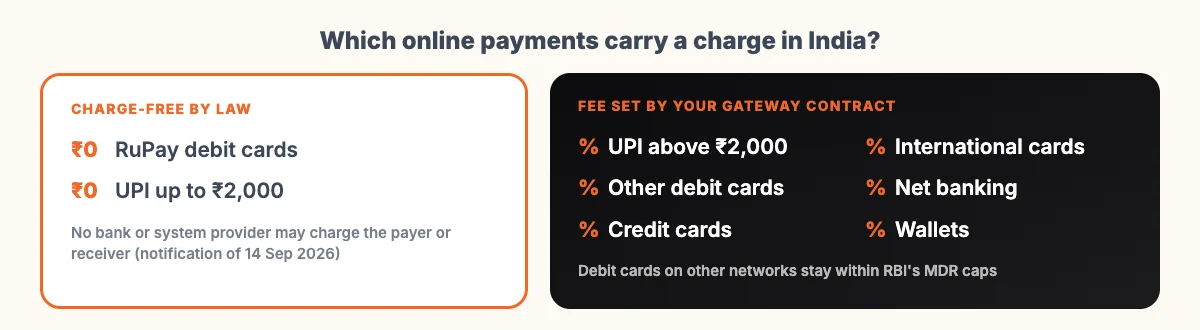
Payment gateway charges in India are fees the merchant pays on each online payment, usually a percentage of the order called the merchant discount rate (MDR). Two kinds of payment are charge-free by law: RuPay debit card payments, and UPI payments of up to ₹2,000. A government notification of 14 September 2026 says no bank or system provider may charge the payer or the receiver for these. Other debit cards, credit cards, international cards and larger UPI payments can carry a fee, and the rate depends on your gateway contract. Before you sign, check the fee for each payment method, when money reaches your bank, and what refunds and chargebacks cost.
This guide explains each type of charge, what the rules say, how to work out the cost on a real order, and what to ask a gateway before you sign. It is general information, not financial or tax advice.
Last reviewed: 15 November 2026. Based on the Ministry of Finance notification of 14 September 2026 and RBI circulars and directions; links at the end.
What are payment gateway charges in India?
When a customer pays on your website, several parties are involved: the customer’s bank or card issuer, the card network or UPI, your bank, and the payment gateway or payment aggregator that connects your site to all of them. The merchant pays for this, mostly through the MDR on each payment. The customer normally pays the order amount and nothing more.
Check the rate card for these charges as well as the MDR:
| Charge | What it is | Where the rate comes from |
|---|---|---|
| Transaction fee (MDR) | A percentage of each successful payment, sometimes with a fixed part | Your gateway contract, within any limits set by law or RBI |
| Payment method differences | UPI, debit cards, credit cards, net banking, wallets and international cards are often priced differently | Your gateway contract |
| Setup or annual fee | A one-time or yearly charge for the account | Your gateway contract; ask whether there is one |
| Refund handling | Whether the original fee is returned when you refund a customer | Your gateway contract |
| Chargeback or dispute fee | A charge when a customer disputes a payment with their bank | Your gateway contract |
| Faster settlement | A charge for receiving money sooner than the standard cycle | Your gateway contract |
Also ask whether each quoted fee includes GST or has GST added on top. Your invoice shows the total.
Which payments are charge-free by law?
The Ministry of Finance notification S.O. 5067(E), dated 14 September 2026 and issued under section 10A of the Payment and Settlement Systems Act, lists two modes of payment as charge-free:
- debit cards powered by RuPay;
- UPI transactions of up to ₹2,000.
For these, the notification says no bank or system provider shall impose any charge, directly or indirectly, on the payer or the receiver. Before 2026 the zero-charge rule for RuPay and UPI came from the Income-tax Act; the 2026 notification now sets it out under the payments law.
UPI payments above ₹2,000 are not on the list. The notification does not set a fee for them, so whether your gateway charges for them, and how much, is a matter for your contract.
What are the debit card and credit card charges?
For debit cards, RBI set maximum MDR rates in a circular of 6 December 2017, effective from 1 January 2018. The caps depend on the merchant’s turnover:
| Merchant | Card payment (physical or online) | QR code payment |
|---|---|---|
| Small merchant, turnover up to ₹20 lakh | 0.40%, capped at ₹200 per transaction | 0.30%, capped at ₹200 per transaction |
| Other merchants | 0.90%, capped at ₹1,000 per transaction | 0.80%, capped at ₹1,000 per transaction |
RuPay debit cards are now charge-free under the 2026 notification, so these caps matter mainly for debit cards on other networks. Check with your gateway whether any later RBI instruction has changed them for your category.
For credit cards, we found no RBI cap on the MDR. The rate is set by your gateway contract and can differ by card type, so ask about international, premium and corporate cards separately. If a large share of your customers pay by credit card, this is the rate to negotiate first.
What do payment gateway charges in India look like on one order?
Take an order of ₹1,500. The fee depends on how the customer pays. In the example below, the UPI and RuPay rows follow the notification. The credit card rate is an assumption for illustration only, not a quote from any gateway.
| How the customer pays | Fee on ₹1,500 | Why |
|---|---|---|
| UPI | ₹0 | UPI up to ₹2,000 is charge-free by notification |
| RuPay debit card | ₹0 | RuPay debit is charge-free by notification |
| Credit card, at an assumed 2% | ₹30, plus GST if your contract adds it | Illustration only; your contract sets the real rate |
If most of your orders are under ₹2,000 and customers pay by UPI, your gateway bill can be small. If customers put higher-value items on credit cards, the fee takes a bigger share of your margin, and it is worth asking for a rate based on your volumes.
How do settlement, refunds and failed payments work?
Settlement is when the money from a customer’s payment reaches your bank account. RBI’s Master Direction on payment aggregators, issued on 15 September 2025 and updated on 11 November 2026, requires a non-bank payment aggregator to keep merchants’ money in a separate escrow account with a scheduled commercial bank. It also requires the aggregator’s agreements with merchants to cover refunds, failed transactions and reconciliation. Check the number of days to settlement in your contract, and ask what faster settlement costs.
Failed payments are covered by RBI’s turnaround time rules of 20 September 2019. For a UPI payment to a merchant where the customer’s account is debited but the merchant does not receive confirmation, the money must be reversed automatically within five days of the transaction (T + 5). If it is late, the customer is owed ₹100 for each day of delay, paid without waiting for a complaint or claim. The same T + 5 rule applies when a card is debited at a shop counter but no charge slip is generated.
A customer whose payment failed will usually get their money back without your help. Even so, keep a short message ready for support staff, telling customers that a failed payment is reversed to their account, and by when.
Questions to ask before you sign with a gateway
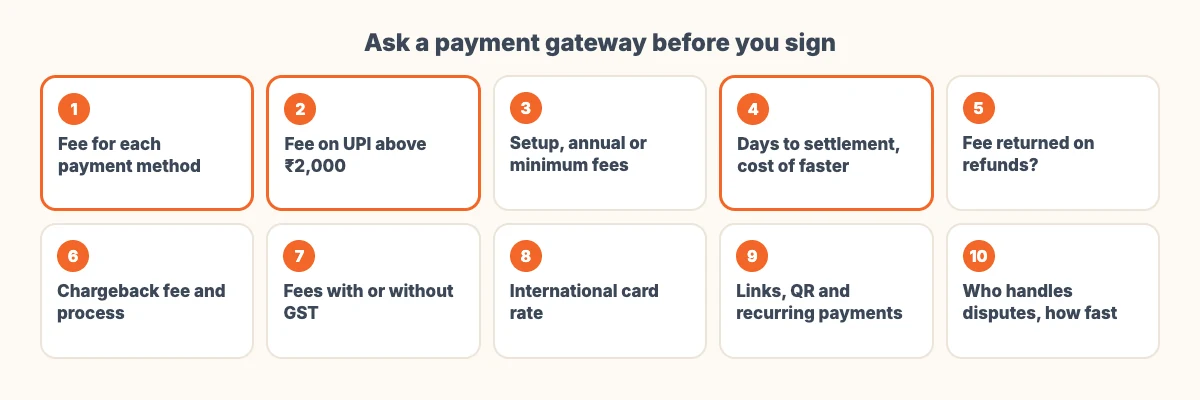
- What is the fee for each payment method: UPI, RuPay debit, other debit cards, credit cards, net banking, wallets and international cards?
- Do you charge for UPI payments above ₹2,000, and how much?
- Is there a setup fee, an annual fee or a minimum monthly charge?
- How many days after a payment does the money reach my bank, and what does faster settlement cost?
- When I refund a customer, is the original fee returned?
- What is the fee for a chargeback, and how do I respond to one?
- Are your quoted fees inclusive or exclusive of GST?
- Can I accept international cards, and at what rate?
- Do you support payment links, QR codes and recurring payments, and are they priced differently?
- Who do I contact when a payment is disputed or stuck, and how quickly do you respond?
Get the answers in writing, ideally as the rate card attached to your agreement. A screenshot of a pricing page can change after you sign.
When a full gateway is not worth it yet
A small seller taking a handful of orders a week over WhatsApp or phone may not need a website gateway at all. A UPI QR code or a payment link from your bank can collect money, and UPI payments up to ₹2,000 are charge-free. The trade-off is manual work: you match each payment to an order yourself, and there is no automatic order confirmation.
A gateway starts to earn its keep when orders come in through your website without you, when customers expect to pay by card, or when you need automatic confirmation, refunds and reports. At that point the hours saved on matching payments usually matter more than the fee.
Adding payments to your website
Most ecommerce platforms connect to the larger gateways through ready-made plugins. A custom site or app needs the gateway’s API wired in, with order status updated from the gateway’s confirmation rather than from the customer’s browser, so a closed tab does not lose an order. Test failed payments and refunds before launch, not only successful ones.
Our ecommerce website development page explains how a store build with payments is usually scoped, and custom web development covers integrations for sites that are not standard stores. If you are still budgeting for the site itself, our guide to website development cost in India lists what drives the price. For order updates sent to customers on WhatsApp after payment, see WhatsApp Business API pricing in India. Our older comparison of selling on your own website versus marketplaces covers the wider choice, and payments that customers authorise through software agents are covered in agentic commerce explained.
Frequently asked questions
Are UPI payments free for merchants in India?
UPI payments of up to ₹2,000 are charge-free. The Ministry of Finance notification of 14 September 2026 says no bank or system provider may charge the payer or the receiver for them. UPI payments above ₹2,000 are not on the charge-free list, so any fee depends on your gateway contract.
What is MDR in a payment gateway?
MDR, the merchant discount rate, is the fee a merchant pays on each card or digital payment, usually a percentage of the transaction. It covers the cost of processing the payment through the banks, the network and the gateway.
Is there a limit on debit card charges?
Yes. RBI’s circular of 6 December 2017 caps debit card MDR at 0.40% (maximum ₹200) for merchants with turnover up to ₹20 lakh and 0.90% (maximum ₹1,000) for others, with lower caps for QR code payments. RuPay debit cards are charge-free under the 2026 notification.
Is there a limit on credit card charges?
We found no RBI cap on credit card MDR. The rate is set by your gateway contract and can differ by card type, so ask for the rate on domestic, premium and international cards separately.
Who pays payment gateway charges, the customer or the merchant?
The merchant pays the gateway’s fee, and the customer normally pays only the order amount. For RuPay debit cards and UPI payments up to ₹2,000, the 2026 notification bars any charge on either the payer or the receiver.
How long does a refund take when an online payment fails?
Under RBI’s rules of 20 September 2019, a failed UPI payment to a merchant must be reversed within five days of the transaction. If it takes longer, the customer is owed ₹100 for each day of delay, paid without waiting for a complaint.
Sources
- Ministry of Finance, Department of Financial Services, notification S.O. 5067(E), 14 September 2026 (PDF)
- RBI, Rationalisation of Merchant Discount Rate for Debit Card Transactions, 6 December 2017
- RBI, Master Direction on Regulation of Payment Aggregators, 15 September 2025, updated 11 November 2026
- RBI, Harmonisation of Turn Around Time and customer compensation for failed transactions, 20 September 2019